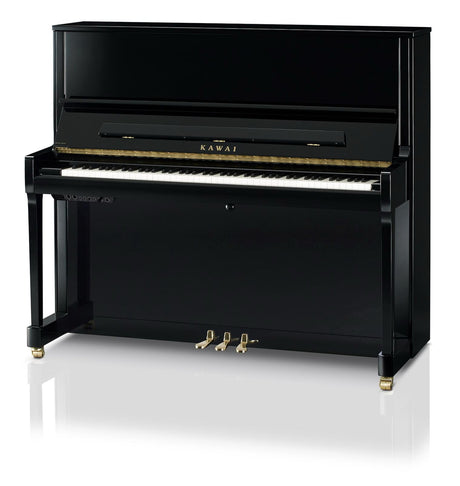
Kawai AURES 2 is an acoustic piano that can also sound digital, without a single built-in speaker. Instead of loudspeakers, the system drives the piano's own wooden soundboard, so the digital sound emanates from the instrument itself.
If you want a piano with a real action but the option to play at a controlled volume at night or in a flat, this is a distinctive solution. This guide explains how Kawai AURES 2 works, which K-series models carry it and who it is for.
01What AURES 2 is: a piano without speakers
AURES 2 is Kawai's soundboard transducer system. At its core it remains a full acoustic piano, with strings, hammer action and a wooden soundboard. Added to that is a digital sound engine, with one decisive twist: there are no external speakers.
Instead, four transducers sit directly on the soundboard. They convert the digital signal into fine mechanical vibrations and channel them into the solid spruce wood. The soundboard, which amplifies the string vibration in acoustic play, becomes the sounding surface for the digital sound. The tone is born inside the piano body, not in a speaker box.
02How it sounds and feels
The digital sound comes from the same large wooden surface as the acoustic tone. As a result it sounds more spatial and natural than classic cone speakers, filling the room from the instrument outward.
The volume is freely adjustable, from quiet practice to full level, or through headphones for yourself. The difference from a plain silent system matters: with AURES 2 the piano stays fully playable acoustically, and the digital sound uses the soundboard as its source rather than hidden speakers. It is Kawai's counterpart to Yamaha's TransAcoustic approach.


03Which Kawai pianos carry AURES 2
AURES 2 is available on the upright pianos of Kawai's K-series. In our range these are the Kawai K-300 Klavier schwarz poliert mit Aures 2 System and the Kawai K-500 Klavier schwarz poliert mit Aures 2 System; the larger K-600 carries the system as well. The sound engine draws on Kawai's SK-EX Rendering, the voice of a concert grand as the digital source.
The models differ mainly in size, scale and the acoustic volume of the underlying piano; the system itself stays essentially the same. A taller cabinet brings more acoustic substance, while the digital behaviour is comparable.
| Model | Character | Suited to |
|---|---|---|
| Kawai K-300 AURES 2 | the versatile classic | home and teaching |
| Kawai K-500 AURES 2 | larger scale, more acoustic volume | demanding play, larger rooms |
| Kawai K-600 AURES 2 | the largest model in the line | large rooms, high demands |
04AURES 2 or a plain silent system: the difference
A classic silent system (Kawai's ATX line) stops the hammers just before the strings, so no acoustic tone is produced; optical sensors read the touch and the digital sound runs through headphones only. AURES 2 goes a step further: the digital sound is reproduced not only through headphones but also audibly in the room, through the soundboard, at an adjustable volume.
So if you want to play more softly in the evening without headphones, call up a different grand voice or fill the room with digital sound, AURES 2 is the right fit. If you only need a headphone mute, a silent system is enough. For more on the distinction, see our piece on silent and TransAcoustic pianos, as well as our overview of what makes a hybrid piano.
Kawai AURES 2 combines a real acoustic piano with the flexibility of a digital sound engine, using the soundboard rather than hidden speakers. That makes it a coherent choice when a genuine action and an adjustable volume both matter.
Frequently asked questions
Does a piano with AURES 2 have built-in speakers?
Does it stay a real acoustic piano?
How does AURES 2 differ from a silent system?
Which Kawai models offer AURES 2?
Is AURES 2 comparable to Yamaha TransAcoustic?
Explore Kawai AURES 2 pianos
The AURES 2 pianos of the K-series and our new pianos at a glance.
View an AURES 2 modelDiscover new pianosPassende Produkte