

The question of when to change ukulele strings comes up for almost every player sooner or later. Strings wear out slowly and quietly, so the loss of tone is often noticed only once a fresh set is on and the instrument suddenly sounds clear and open again.
This guide answers the when and how often: how to recognise worn strings, what lifespan to expect and why a timely change is worth it. The step-by-step instructions for fitting strings are covered in a separate article.
01The signs: how to spot worn strings
Four signals show that a string set has reached the end. They usually appear together.
The tone turns dull and muddy. Fresh strings sound clear, bright and with a long ring. Worn strings lose exactly that: the tone becomes flat, short and lifeless, treble and brilliance are missing.
The tuning no longer holds. As strings age they lose their elasticity and with it the ability to hold tension steadily. If you find yourself retuning far more often than before, that is a clear sign.
The intonation drifts. Worn strings sound off in the higher positions, the pitch sits beside the true note even when the open string is tuned correctly.
Visible wear. At the points where the string meets the frets, notches, grooves or discolouration form. Such wear marks weaken the string and worsen tuning and intonation further.
02How often to change: the typical lifespan
There is no fixed number of weeks, wear depends heavily on the player. As a rough guide: with regular playing, ukulele strings last from a few months to about a year. Heavy players tend to change every few months, occasional players often get six to twelve months.
Two factors speed up wear: hand sweat and climate. Salts and acids from the skin attack the material, high humidity and temperature swings do the rest. Anyone who plays a lot with damp hands therefore changes more often than average.
Our tip: do not rely on the calendar alone, rely on your ear. As soon as the tone fades or the tuning no longer holds, a change is due, no matter how old the set is on paper.
03Why fresh strings bring back tone and tuning stability
A new set restores two things that fade away gradually: tonal colour and tuning stability. Fresh strings vibrate more freely, the tone becomes clear, bright and expressive again, and the instrument responds noticeably more easily.
At the same time a new set holds the tuning reliably again, because the elasticity is back. One small caveat right after the change: new strings stretch over several days and keep going out of tune at first. That is normal. After a short break-in period the tuning settles by itself.
You will find the right strings in our Ukulelen - Saiten category, sorted by size and material.
04Strings are size-specific: the right set
Important before you buy: ukulele strings are size-specific. Soprano, concert and tenor each need their own set, matched to the scale length. The standard tuning of these three sizes is G-C-E-A with a high G string. The baritone ukulele is tuned lower to D-G-B-E and needs its own baritone set; just ask us about one. The bass ukulele also has its own set.
A quick look at the material pays off. Nylon sounds soft and warm and is inexpensive. Nylgut, for example from Aquila, is a synthetic gut material with a warm, traditional tone and good tuning stability, a near-standard for many. Fluorocarbon, for example from Martin, sounds brighter and more precise, is thinner and stable. Titanium from D Addario offers more projection and a smooth, pleasant feel.
Which material suits which playing style is something we go into in a dedicated article on choosing strings.


05Always keep a spare set on hand
A string can break, or the tone can fade just when a gig or a rehearsal is coming up. Anyone with a matching spare set in the drawer is not left unable to play overnight.
For the tenor ukulele, the D'Addario EJ87T Titanium Ukulelensaiten Satz, Tenor give you a high-projection set with a smooth feel. For soprano and concert, sets like the Aquila Ukulelensaiten Satz 4U Sopran in warm-sounding nylgut are a proven choice. If you want to move from high to low G, the D‘Addario EJ65TLG Saiten für Tenorukulele Low G make a suitable Low-G set.


In short: change as soon as the tone fades, the tuning no longer holds or the strings are visibly worn. A fresh set matched to the size brings back clarity and tuning stability, and a spare set in the drawer saves you nasty surprises.
Frequently asked questions
How often should you change ukulele strings?
How do I know my ukulele needs new strings?
Why does my ukulele keep going out of tune after a string change?
Can I use soprano strings on a tenor ukulele?
Fresh strings for your ukulele
Find the right set by size and material in our category.
All ukulele stringsD Addario Titanium tenorPassende Produkte

Aquila Ukulele String Set 4U Soprano
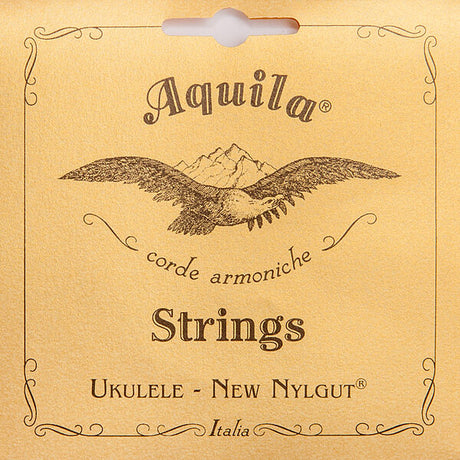
Aquila ukulele string set 7U concert

Aquila Ukulele String Set 10U Tenor


D'Addario EJ87T Titanium Ukulele String Set, Tenor


Martin M600 Fluorocarbon Ukulele Strings Soprano/Concert