Recorder, clarinet, flute or saxophone: anyone facing a child's first instrument, or a wind-class placement at school, tends to ask the same question. The four instruments sound very different, but they also place very different demands on physique, breath technique and patience.
This comparison lines up the four instruments against the criteria that matter most in practice for parents: what age a realistic start is, what the instrument demands physically, how loud it sounds, and how much maintenance it needs.
01Recorder: the tried-and-tested first step
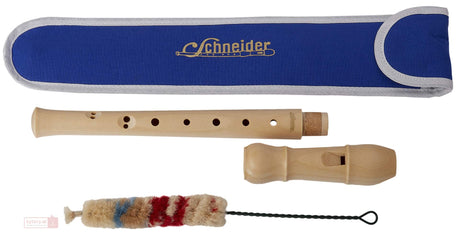
The soprano recorder is, in most music schools and primary schools, the first instrument, before a wind instrument with a mouthpiece even comes into play. It needs no embouchure in the strict sense: the sound is produced purely by the airstream across the labium, not by a reed or an embouchure hole that first has to be mastered. The finger positions are also easy for small children's hands to grasp.
The recorder is therefore less a destination instrument than an entry point that teaches note-reading, finger technique and breath control before a child moves on to clarinet, flute or saxophone. Baroque and German fingering differ in the finger sequence, and it is usually the school, not the family, that decides which fingering applies. A well-established model for getting started is the Schneider Sopranblockflöte Modell Primus barocke Griffweise.

02Clarinet: embouchure, tonguing and many keys
The clarinet works with a single reed fixed to the mouthpiece. That requires a trained embouchure and a tonguing technique that starts and stops the note cleanly, both of which take some patience in the first few weeks. On top of that comes a dense key system that engages the fingers of both hands.
For beginners, the ABS resin student model has established itself over the wooden clarinet: it is less sensitive to changes in temperature and humidity and therefore needs less maintenance than a wooden body, without giving up much in tone. The Yamaha YCL-255 S Klarinette Böhm-System is such a beginner model with a Boehm system, the widely used key system.
03Flute: an embouchure hole instead of a mouthpiece
Unlike the clarinet and saxophone, the flute has no reed. The sound is produced by blowing the airstream across the embouchure hole in the headjoint, a principle that often takes several attempts before the first clear note. The flute is held to the side, which brings a slightly asymmetric posture that children generally get used to quickly.
Student models with closed keys are easier to handle at the start than open ring keys, which additionally require precise finger placement. The Yamaha YFL-212 Querflöte – versilberte Schülerflöte mit Split-E-Mechanik (Neusilber, Offset-G, C-Fuß) is such a student model with a closed key system and a silver-plated body.
04Saxophone: shoulder strap and physique
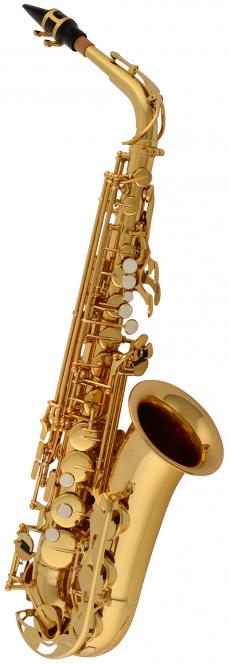
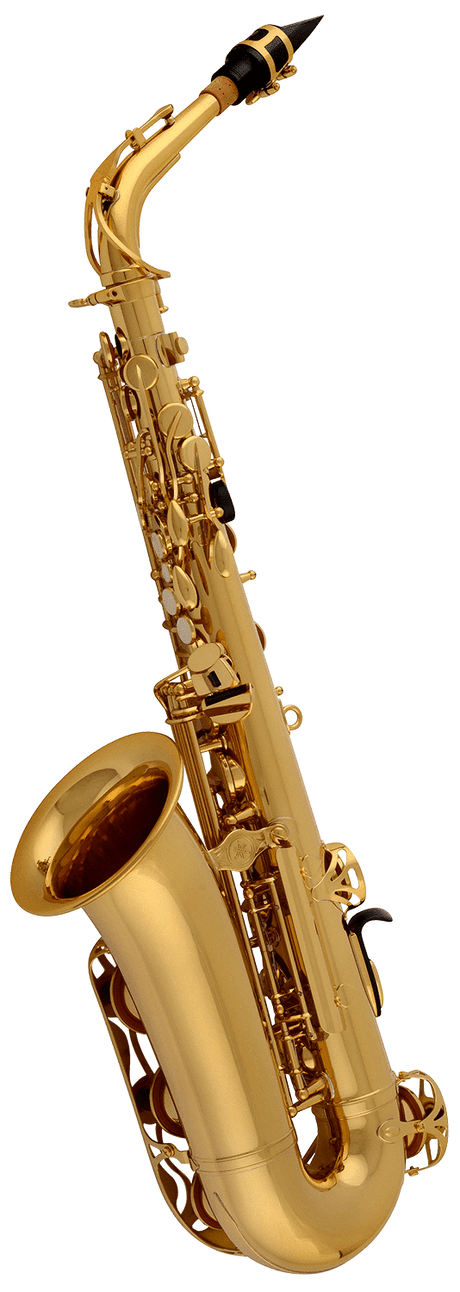
Within the saxophone family, the alto saxophone is the usual starting point: noticeably more manageable than the tenor or baritone, but already a fully-fledged instrument in sound and key mechanics. A neck or shoulder strap carries the weight, leaving the hands mainly free for finger technique, though the saxophone still calls for somewhat more breath support and finger span than the recorder or clarinet.
The reed sits on a mouthpiece as with the clarinet, but the embouchure is looser and needs less lip tension. The Yamaha YAS-280 Altsaxophon in Es – Gelbmessing-Korpus, goldlackiert (zweiteiliger Becher, Mundstück 4C & Leichtkoffer inkl.) is the widely used beginner alto saxophone, supplied with a lightweight case and mouthpiece.

05All four at a glance
The table below summarises the four instruments against the criteria that matter most in practice. It does not replace trying an instrument in hand, but it gives a first orientation before the decision is made or a wind class assigns instruments.
Anyone weighing up clarinet, flute and saxophone should above all compare the sound: warm and round for the clarinet, bright and rich in overtones for the flute, full and carrying for the saxophone. Our Blockflöten category shows further recorder models for the first step.
| Instrument | Starting age | Physical demands | Volume | Maintenance |
|---|---|---|---|---|
| Recorder | often from age 6, no prior skills needed | no reed embouchure, small finger span is enough | quiet to moderate | low – wipe down, occasional oiling for wooden models |
| Clarinet | often from age 8-9 | lip embouchure on a single reed, dense key system | moderate | moderate – reed care, greasing corks |
| Flute | often from age 8-9 | sideways posture, embouchure hole takes patience at first | moderate to loud | low to moderate – wipe out after playing |
| Saxophone | often from age 9-10 | shoulder strap helps, larger finger span needed | loud | moderate – reed care, keep an eye on pads |
The recorder is almost always the easiest first step, because it needs no reed embouchure. Choosing between clarinet, flute and saxophone comes down to physique, sound preference and the timeline of a wind class together, and the table above gives a first orientation.
Frequently asked questions
Which wind instrument is easiest to start with?
At what age can my child start clarinet, flute or saxophone?
Why is the alto saxophone almost always recommended first?
What is the difference in embouchure between clarinet and flute?
Can my child switch instruments later on?
Find the right wind instrument
From the soprano recorder to the alto saxophone, the beginner models at a glance.
Browse all recordersDiscover the Yamaha YAS-280Passende Produkte