Practise a real piano without disturbing the neighbours or the sleeping kids: that is exactly what Kawai AnyTime ATX is built for. The system sits inside a fully acoustic upright or grand piano and switches, at the touch of a control, to a digital sound that only you hear through headphones.
The key difference from a pure digital piano matters here: with Kawai AnyTime ATX the instrument stays an acoustic piano with real strings and real action. The ATX system only engages when you need it. This guide explains how it works technically, which Kawai models carry it, and how it differs from the related AURES system.
01What Kawai AnyTime ATX is
AnyTime is Kawai's family of hybrid pianos: a normal acoustic instrument with an added silent and digital system. ATX is the silent variant of it. The current generation is called ATX4, while the smaller models use the ATX3L variant.
The basic idea: during the day you play like on any acoustic piano, with the full, room-filling sound of the strings. In the evening you engage a lever, put on the headphones and keep practising without any acoustic sound leaving the room. The action under the keys stays the same, the playing feel does not change.
02How the silent system works
Two things happen when you switch to silent mode. First, a stop rail engages the action and catches the hammers just before they strike the strings. The strings are not struck, so no acoustic sound is produced. On the grand piano models a particularly fine stop mechanism handles this, so the touch stays natural right to the end of the keystroke.
Second, contact-free optical sensors read how fast and how hard each hammer moves. From these readings the digital sound engine generates the matching tone, which you hear through headphones. Because the sensors capture the real hammer movement rather than just a key contact, the digital sound reproduces the dynamics of your playing very accurately. The instrument remains fully playable acoustically at any time, as soon as you release the stop rail.
03Which Kawai models offer ATX
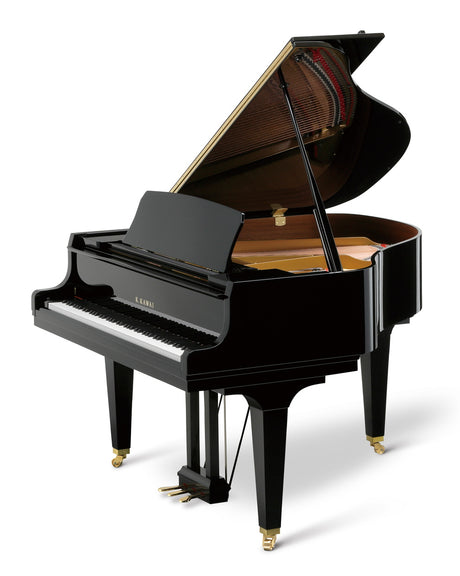
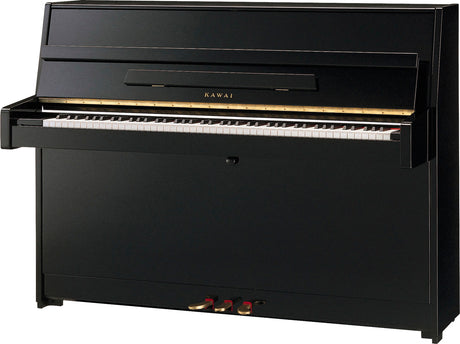
The ATX system is available both on the upright pianos of the K series and on the entry-level GL-10 grand piano. Among the uprights the range runs from the compact K-15 through the popular K-200 to the larger K-300, with its longer scale and accordingly rounder, fuller tone. On the GL-10, the ATX technology sits inside a genuine baby grand with grand piano action.
Good examples from our range: the Kawai K-200 Klavier schwarz poliert mit ATX4 Silent System as a balanced mid-range upright, the Kawai K-300 Klavier schwarz poliert mit ATX4 Silent System for more tonal volume, and the Kawai Flügel GL-10 schwarz poliert mit ATX4 Silent System for anyone who wants to combine grand piano action with the silent function. The compact Kawai K-15 Klavier schwarz poliert mit ATX3L Silent System carries the slightly leaner ATX3L variant.


04ATX or AURES: the decisive difference
Both systems come from Kawai's AnyTime family and share the same basic idea: an acoustic piano that can be played silently and digitally. The difference lies in how the digital sound reaches the outside.
ATX is the silent variant: you hear the digital sound only through headphones. The instrument stays quiet to the outside. AURES, by contrast, has built-in transducers that make the piano's soundboard vibrate. The digital sound then becomes audible in the room, without headphones and without separate speakers. AURES suits you if you want to hear the digital sound openly in the room, ATX if true silence while practising takes priority. To learn more about hybrid pianos without strings and how they compare, see our article on hybrid pianos.
Kawai AnyTime ATX answers the most common wish when buying a piano: a real acoustic instrument that can be played silently when needed. If you want the full string sound during the day and undisturbed practice in the evening, this system combines both in a single instrument. The choice between K-15, K-200, K-300 and the GL-10 grand depends on tonal volume, cabinet form and available space.
Frequently asked questions
Is a Kawai ATX a digital piano?
How does the piano go silent for practice?
What is the difference between ATX and AURES?
Which models offer ATX?
Does the ATX system change the playing feel?
Discover Kawai AnyTime ATX in our range
Browse the current Kawai pianos with silent system and find the model that fits your room and playing needs.
View new pianosKawai K-300 with ATX4Passende Produkte


Kawai K-200 upright piano polished black – 114 cm height, ATX4 Silent system, Millennium III action