

Anyone who wants to practise in the evening without filling the whole home with sound quickly runs into three terms that are easy to mix up: Silent, TransAcoustic and hybrid. The difference between Silent, TransAcoustic and hybrid is not just about volume, but about what happens technically inside the instrument and whether real strings still sound.
In short: a Silent piano switches off the strings and sends a digital sound to the headphones. A TransAcoustic piano keeps the strings and also uses the soundboard as a speaker. A hybrid piano has no strings at all, but a real piano action. This article sorts the three ways by touch, sound, space, price and maintenance, and explains which one suits whom.
01Way 1: Silent, the strings are switched off
A Silent piano is first of all a full acoustic piano with hammer action and strings. When you switch on Silent mode, a hammer stop rail moves between the hammers and the strings: the hammers are caught just before they reach the strings, so the instrument stays mechanically silent. At the same time, optical sensors read which key is played and how fast, and create a digital piano sound that you hear through headphones.
You therefore still play on the real action with the familiar touch, only the sound of the strings is gone. During the day it stays an ordinary acoustic piano, in the evening it becomes silent. Yamaha calls its system SC3 or SH3 depending on the model, Kawai offers the comparable ATX technology, Schimmel the Twin Tone system. For a deeper look at this design, see our article on Silent and TransAcoustic pianos.


02Way 2: TransAcoustic, the soundboard becomes the speaker
A TransAcoustic piano goes one step further. Here too the action and strings remain, but the system needs no external speakers and usually no headphones. Instead, a transducer sits on the soundboard. It sets the wood itself into vibration, so the digital sound comes from the body of the piano, just like the acoustic tone normally does.
The advantage: the volume can be adjusted steplessly, and the sound stays spatial and natural because it comes from the same wood. During the day you play acoustically through the strings, in the evening you turn it down and the soundboard takes over. Yamaha calls the system TA3 or TC3, Kawai offers a comparable solution with AURES and AURES2. If you want to keep the natural wooden sound and only tame the volume, this is the right way.
03Way 3: hybrid, a real action with no strings at all
A hybrid piano turns the principle around. It has a real wooden piano or grand action, so the same touch as an acoustic instrument, but no strings and no soundboard. The sound is created entirely digitally. Yamaha builds this category as the AvantGrand range, Kawai as the Novus series, Casio with the Celviano Grand Hybrid GP-310.
Because no strings are under tension, a hybrid never needs tuning, stays stable in sound and lets you adjust the volume or switch to headphones at any time. An important distinction: a hybrid is not a Silent piano. On a Silent instrument the strings are still there and only muted, on a hybrid they do not exist at all. Our article that explains hybrid pianos goes into detail. One side note: Casio and Roland generate their sound through modeling, a calculated sound synthesis, while Yamaha and Kawai rely more on sampled recordings of real instruments, an audible difference in sound character.
04The direct comparison at a glance
The three ways solve the same task, being able to practise quietly, in very different ways. What matters is what you want to keep: the acoustic sound experience, the real action or complete freedom from maintenance. The table sets out the main differences.
| Feature | Silent | TransAcoustic | Hybrid |
|---|---|---|---|
| Strings present | Yes, can be muted | Yes, stay active | No |
| Quiet sound comes from | Headphones | Soundboard | Speakers or headphones |
| Touch | Real piano action | Real piano action | Real action, no strings |
| Playable acoustically | Yes | Yes | No, digital only |
| Tuning needed | Yes, like a piano | Yes, like a piano | No |
| Footprint | Like a piano | Like a piano | Often more compact |
| Price tendency | from mid level | somewhat higher | broad, compact to grand |
05Which way suits whom
Silent is the right choice if you want a real acoustic piano with everything that goes with it and only need to practise silently now and then, for example late in the evening in a rented flat. During the day you have a full piano, at night the headphones.
TransAcoustic is worthwhile if the natural wooden sound matters to you, but you mostly want to play more softly rather than completely silently. The soundboard keeps the spatial sound quality that headphones never fully capture.
Hybrid is ideal if you value the real piano action and touch, but want to avoid tuning, sensitivity to room climate and often the footprint of a string instrument. If you are still unsure between an acoustic piano and a digital piano, our comparison of digital piano versus acoustic piano covers the basics. You will find all three ways in the Klaviere - Neu.
All three ways lead to quiet playing, but through different technology. Silent switches off the strings, TransAcoustic turns the soundboard into a speaker, hybrid does without strings entirely. If you want to keep the acoustic experience, stay with Silent or TransAcoustic; if you value freedom from maintenance and a compact form, look to the hybrid.
Frequently asked questions
What is the difference between Silent and hybrid?
Does a TransAcoustic piano need speakers or headphones?
Does a hybrid piano need tuning?
Can I play a Silent piano normally as an acoustic?
Which way is the cheapest?
Find the right way to practise quietly
Compare Silent, TransAcoustic and hybrid models at your leisure and find the instrument that fits your living situation.
Browse new pianosDiscover the Yamaha B30 SilentPassende Produkte


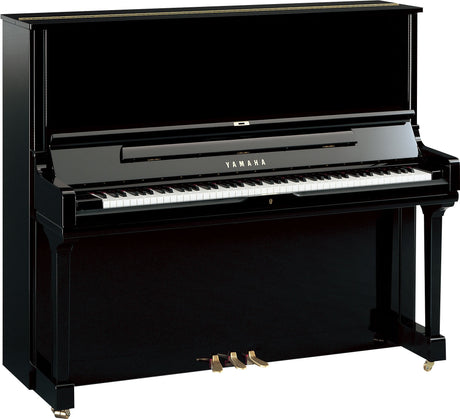

Yamaha YUS-3 Upright Piano in Polished Ebony with TA3 Transacoustic System